

By Abbie Amick, June 21 2022
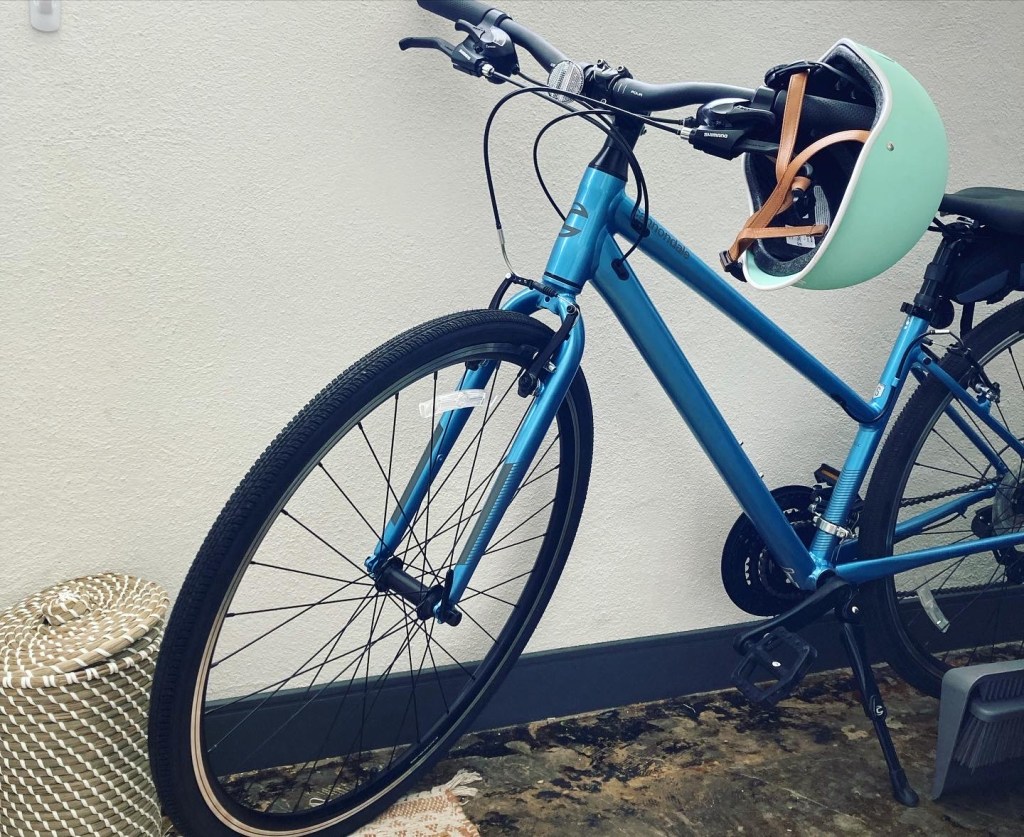
I bought a bike last week.
Even though I’m not good with bikes, I got this one hoping to commute to and from UNC campus while working toward my MA in linguistics. Over the last few years, I’ve seen professors, students, and close linguist friends riding around on their bikes to research, learn, and teach. And today, as I was daydreaming about pedaling around Chapel Hill to study linguistics myself, I was reminded: from mail-in dialect surveys to the OG Tour de France to second language instruction in Taiwan, bicycles actually have a place in the history of linguistics.
Georg Wenker and linguistics by mail
The use of bicycles for linguistic research started (as far as I know) in the 19th century. Studies in dialectology sometimes have to cover a lot of ground, and researchers have to get creative with their transportation.
In the 1870’s, Georg Wenker gathered dialect information from all over mainland imperial Germany using the postal service. He wrote up a questionnaire of 40 sentences, written in standard German, and mailed it off to schoolteachers all over northern Germany. The questionnaire mostly consisted of simple, universal sentences that you would hear in any household /s, like ich schlage dich gleich mit dem Kochlöffel um die Ohren, du Affe (I’ll hit you on the ears with this spoon, you ape). The teachers then had to rewrite the sentences the way the locals in the area would say them. Wenker got about 45,000 responses mailed back to him, which he eventually compiled into the Deutscher Sprachatlas.
Wenker’s questionnaire wasn’t sent out to the schoolteachers on bicycles. From what I can tell, mail in the German Empire was mostly transported on trains. HOWEVER, the results of Wenker’s work inspired other linguists to pursue some large-scale dialect research: this time making use of some (more modern) German engineering.
Edmond Edmont and the ultimate Tour de France

Wenker’s study had one major limitation: it was all written. The schoolteachers that filled out the questionnaire wrote the sentences semi-phonetically based on what they heard. It was up to them to spell the word Wort (word) as Wort, Woort, Woord, Word, Wurt, Wurd, etc., and those spellings were all Wenker had to work with.
A few years after Wenker’s first round of questionnaires, Jules Gilliéron designed a dialectological study of French towns, this time sending field workers out to gather data in person. One of those field workers was Edmond Edmont, who traveled through hundreds of towns to conduct interviews—yes, on a bicycle.
Edmont spend four years cycling across France and interviewing speakers of local dialects, transcribing the elicited utterances with a standardized notation. Pedaling for miles and miles to get his ears in front of every speaker allowed him to get more consistent speech data. Edmont contributed tons of work to what later became the Atlas Linguistique de la France.
Using cycling lessons for second language instruction
The relationship between bikes and language also goes beyond research and into education. According to this article, Kevin Milligan incorporated cycling lessons into his immersive English class at an elementary school in Taiwan. He would lead a classroom session, teaching vocabulary for bike parts and cycling activities, and then follow up with a practical lesson, encouraging the kids to help each other using the new vocabulary.
I haven’t studied second language acquisition in depth, but I personally love practical language education. I’ve used yoga routine videos to help my German language learning for years, and I’ve used recipes and drawing tutorials as part of tutoring sessions. I think cycling lessons would be a great avenue for practical language instruction.
Other random connections between linguistics and bicycles
And to finish off, these are just some fun facts. Even though they don’t warrant their own sections, they show some more small connections between linguistics and bicycles.
- Linguist and cognitive scientist Steven Pinker is an avid cyclist.
- Noam Chomsky (ol’ Papa Chomskers of linguistics) attributed his long life and career to the bicycle theory: “as long as you keep riding, you don’t fall.” He’s 93 now, so I’m inclined to believe him. (Einstein expressed the same sentiment)
I find all the cycling linguists, from Edmont to Pinker to my own mentors, really inspiring. I’m excited to join in on the tradition.
Do you know more about the people and studies I mentioned in this post? Do you agree or disagree that cycling lessons make for good second language training? Feel free to leave a comment or reach out to me directly. I’d love to chat about it!
 LingFrog
One response to “Bicycles and Linguistics (they’re kind of related)”
Very fun post and well written. :->
I think that incorporating movement into the learning process is, indeed, valuable. Our minds rather like the challenge. In an interesting way, the added activity helps to compartmentalize distractions and focus our thoughts, thus allowing us to better take in the information that we are working to absorb. Think about the benefit of fidget gadgets, and people standing at the wailing wall in Jerusalem rocking back and forth while they read and pray. Rather than being annoying and pulling attention away, the movement calls on more of the brain to engage and work at the same time. The multi-tasking requires greater concentration, and the greater concentration enhances the learning. It’s all rather fascinating, really.
LikeLike